
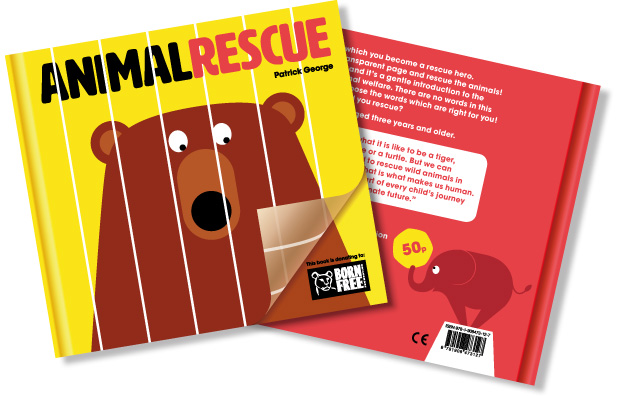
There are several issues I would like to bring up from an abolitionist vegan viewpoint, however. To begin with, just three of the eleven spreads focus on "food" animals: fishes, chickens and sharks (with regards to shark fin soup). The fact that there are so few is problematic in itself, considering that the vast majority of animals used by humans are used for food. Including just three examples reduces the scale of farmed animals' plight and puts unfair emphasis on saving wild animals instead. Although this is hardly surprising given that the book was made in conjunction with a conservation charity, it is disappointing nonetheless. Additionally within these three examples there are some rather glaring problems which I will discuss in more detail.
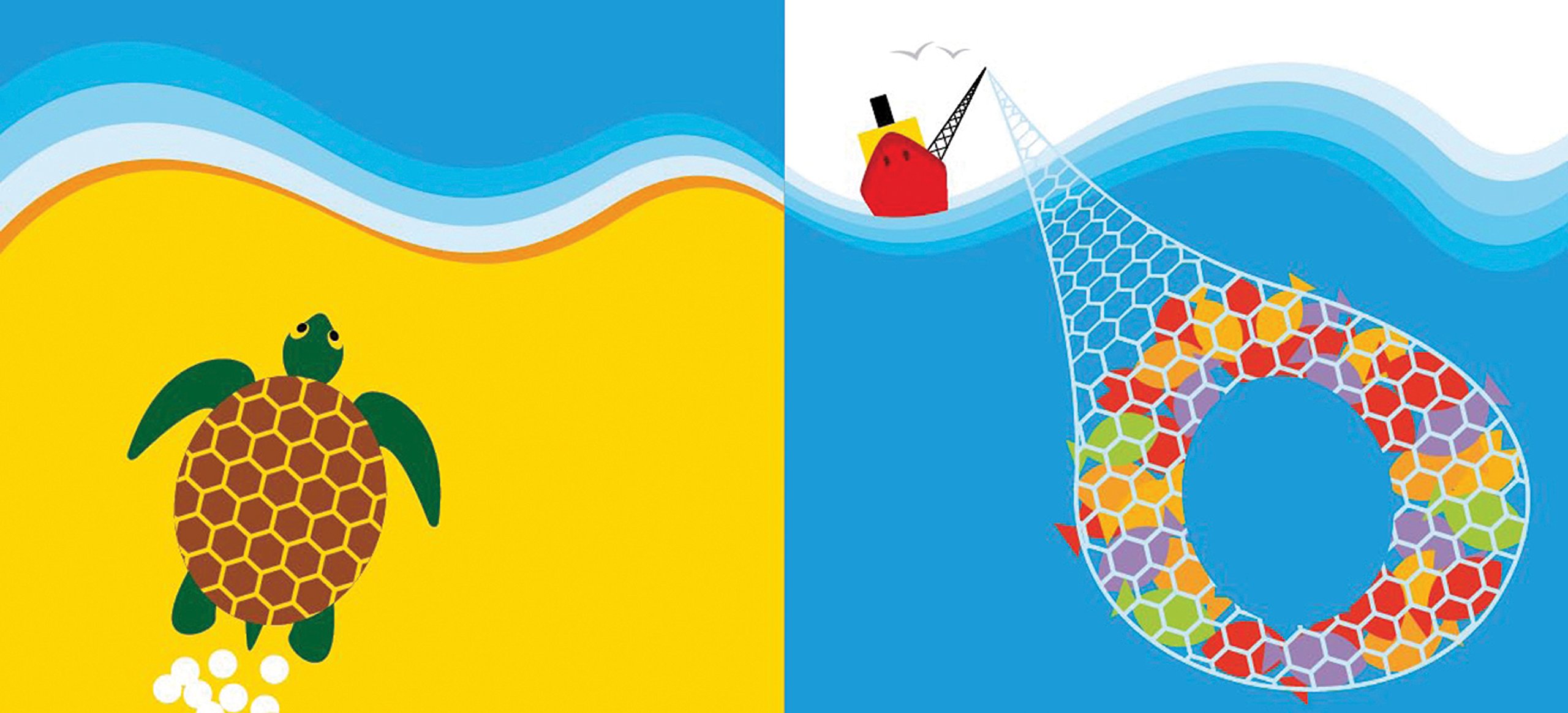
The fishing spread shows a trawler and net full of fish and a turtle on the right hand page. When we turn the acetate, however, only the turtle is rescued; the faceless, featureless fish are left in the net to suffer and die in order to become food. Removing the fishes' faces and features strips them of their individuality and suggests they are unable to feel in the same way as other animals. This may have been a conscious design decision in order to keep the book's minimal aesthetic consistent, but it is still an issue. Saving only the turtle may also be a fault of the design, as it is the similarity between the pattern on the turtle's shell and that of the net that makes the game effective. However the notion that we should save turtles, but not fishes (we are not even given the option to rescue the fishes) is highly speciesist.
The next spread confronts the reader with a similar dilemma, but this time there isn't even a distinction between species. We are presented with the choice to liberate some chickens from an overcrowded, grey, prison-like shed into an open field which is inhabited by a solitary rabbit. I believe the inclusion of the rabbit helps distinguish this field from a free-range farm, but I could be mistaken. When we turn the plastic page we rescue a handful of hens, but the majority remain in the factory farm and we have no option to save them. To me, this certainly doesn't imply abolition, but instead it suggests that not all animals can, or should, be free. It also implies that factory farming and the way we treat farmed animals is the problem, rather than the fact that we use them at all. Again, this could be attributed to a design flaw - I believe it could have been possible to design a spread which allows the reader to liberate all of the chickens. It also would have been braver to show not just a factory farm, but a family farm, a humane farm in order to explain that all animal use is oppressive and exploitative.
Next we have the spread on shark fin soup. Although visually this is one of my favourite designs in the book (it is beautifully composed), shark fin soup is eaten by a small proportion of humans and again the emphasis is taken away from farmed animals and placed onto wild animals. There is often some degree of xenophobia in animal rights' criticism of shark fin soup - although that is not explicit here, it may enter into the discussion between parent and child.
One final criticism is of the last double page spread in the book which poses the question: "Which animals would you rescue?". Now of course one would hope that any child (or adult) would answer "all of them!" with glee and without hesitation. But the use of the word "which" implies that potential answers could include "some of them" or "none of them". Again this seems potentially speciesist and relies on parents' understanding of animal use to further explain the issues. In the non-vegan world we live in, this could result in speciesist conclusions to be drawn, particularly in the examples analysed above.
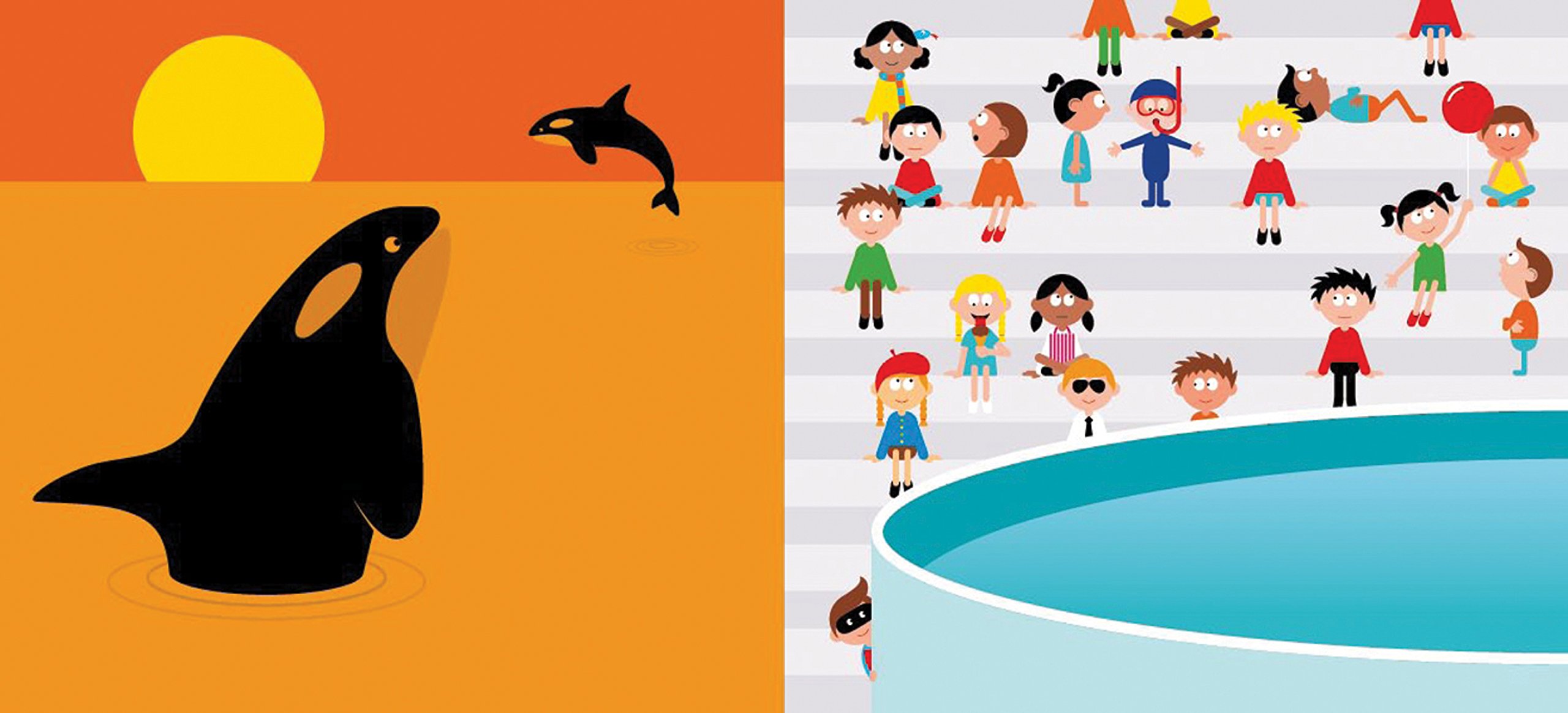
One key positive is the way each spread is concerned with animals as individuals (aside from the fishes in the net) and the focus is on their experiences, from their point of view. This helps us to empathise and realise that animals exist for their own reasons, not for human gain. The people the Seaworld-style aquarium look perfectly happy even after the whale is liberated; the glamorous woman still looks fashionable, comfortable and warm, even without her fox fur stole; life without animal exploitation is neither limiting nor deprived.
Conceptually the book is highly inventive, there are some very clever uses of the format and the bold artwork makes it visually very successful. Turning the pages is a fun and engaging way to approach difficult subjects which are seldom confronted in picture books. Although the omission of more examples of farmed animals is a missed opportunity, and there are some disappointing displays of speciesism, I do think that this book succeeds in allowing the reader to question why we use animals in certain ways. Being almost wordless helps children to draw their own conclusions, rather than being told what is right or wrong. I'm sure the book will provoke many thoughtful conversations between parents and children, perhaps even allowing parents to question their own animal use in more depth. I would be keen to see another in the series that focuses purely on farmed animals as it is clear that the Born Free Foundation's focus on conservation has taken centre stage here. Despite its flaws, I would recommend this book to other vegans and to those looking to explain animal issues to young children.
See the trailer for the book below:
‘Animal Rescue’ by Patrick George from PatrickGeorge on Vimeo.


